

Acts of Deceit: How ‘Places of Worship Act’ Legitimizes Historical Injustice Against Hindus
 Nitin Sawant · 02/04/2025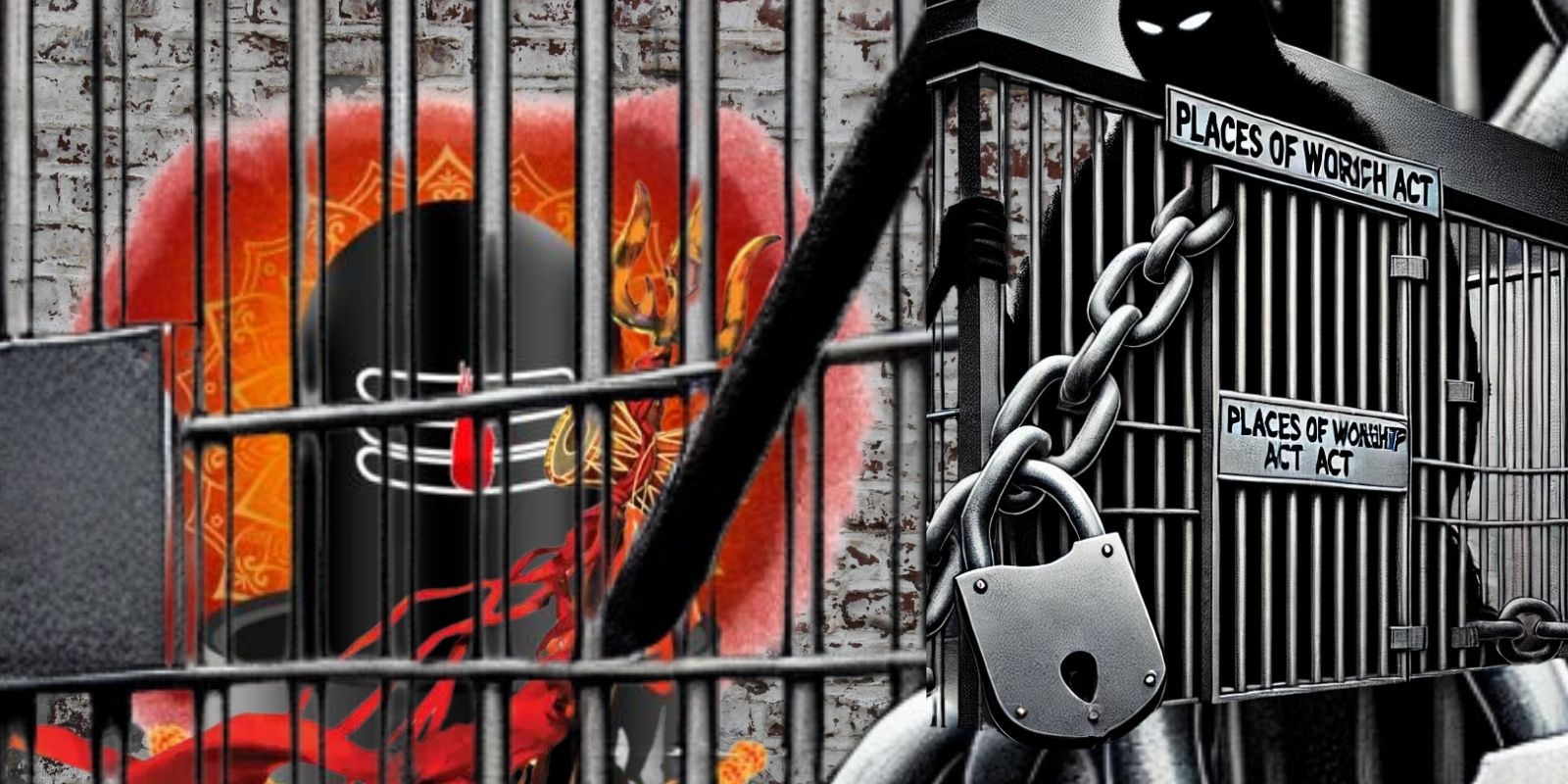
- The Places of Worship Act, 1991 (POWA), is criticized as legitimizing historical injustices against Hindus by barring them from reclaiming sacred sites desecrated or converted by invaders, thus denying their cultural and religious heritage.
- POWA is portrayed as a tool of pseudo-secularism, hastily enacted by Congress to appease its Muslim vote bank, while suppressing Hindu rights and empowering Islamists under the guise of protecting secularism.
- The Act’s arbitrary cut-off date of August 15, 1947, fails to account for centuries of destruction and desecration, exposing its inherent bias. Moreover, the lack of prosecution for post-1947 temple destruction highlights the double standards.
- POWA’s provisions are criticized for violating constitutional rights (Articles 14, 15, 25, 26, and 29), and its vague language has led to numerous legal and interpretive challenges that question its validity.
- Critics emphasize the need for an inclusive dialogue with all stakeholders, akin to reconciliation mechanisms in other nations, to address historical grievances and reform laws like POWA that perpetuate injustice and suppress cultural identity.
Steve Biko, a well-known anti-apartheid activist from South Africa, was frustrated when White Western outsiders tried to control the discussion about racism in his country. He believed that only the victims—Black South Africans—had the right to define their own experiences of injustice. Biko strongly opposed the idea that foreigners could decide how racism should be understood. He was right to say that those who suffered should have the power to explain their pain, not the people who caused it. His ideas later influenced the creation of the Truth and Reconciliation Commission, which began a long-drawn process of healing a fractured nation.[1]
After World War II, many countries followed a similar process of addressing past injustices as part of decolonization. Examples include Nuremberg, Chile, Rwanda, Bosnia, Spain, and Colombia.[2] Although the results were sometimes superficial or unsatisfactory, the idea of offering justice to victims had value. And so it continued worldwide, except in India – a country that had suffered civilizational plunder from waves of Abrahamic invaders for over a thousand years.[3]
The moot question is: Why didn’t India formally constitute a redressal mechanism post-1947 against all its invaders? And why was our limited anti-colonial sentiment directed only towards the British, who had ruled over India for the previous 200 years, but not towards the earlier Islamist invaders who had not only sought to plunder but had also intentionally worked towards damaging and violating the religious fabric? The answer is far more complex, and the blame lies hugely on some of the republic’s founding fathers.
How Pseudo-Secularism Sold Out India’s Soul
When India was partitioned along religious lines in 1947, leading to the creation of Pakistan for Muslims—who had voted for a separate nation due to their inability to coexist with Hindus—it was widely expected that the newly formed Republic of India would embrace the traditional Sanatan values of the land while maintaining its genuine secular character. However, what followed was a bizarre reign of unilateral and unchallenged pseudo-secularism, whereby the reconstruction of the plundered iconic Somnath Temple was seen as a glaring aberration by the Congress establishment in power, as they persistently worked towards denying their heritage continuum and living up to some secular neverland dystopian ideal that emasculated all Hindus and empowered all Muslims. Why? Because Muslims make for a strong voting bloc in their favor, and appeasing them meant that the Congress Party could cling on to electoral power forever.
Indeed, it is fair to say that while the Indian Republic was liberated in 1947, the Hindu society remained shadow-enslaved, as they were persistently denied the right to worship in their traditional temple venues — many of which were seized and converted into mosques by Islamist invaders. The only temple restoration movement that genuinely rattled the establishment was the Ayodhya Ram Mandir, as the dispute had been in court since the British Raj. Naturally, the enfeebled and demoralized Hindu community united behind the Ayodhya cause, which alarmed the ruling establishment. They feared that if Hindus could mobilize for Ayodhya, they might soon demand the return of other sacred sites that had been unlawfully taken. To permanently throttle the idea of sacred worship sites in Hinduism, they came up with ludicrous legislation that denied any official redressal mechanism to the Hindus to reclaim their traditional places of worship. Significantly, Hindus were not demanding retribution for the past Islamist pogroms against them. But since an awakened Hindu is one voter out of the pale of the Congress-Left, the establishment chose to slap the ‘Places of Worship Act 1991’ to garrote any Sanatani revival.
What is the ‘Places of Worship Act 1991’ (POWA)?
Back in 1991, when the disputed structure of Babri Masjid still stood in Ayodhya, and opposition leader LK Advani’s Rath Yatra was mobilizing support in favor of the Ram Janmabhoomi Mandir, this “poorly drafted and vaguely crafted”[4] legislation was rammed through the Parliament by the ruling party to assuage the sentiments of its minority voting bloc of Muslims. “It is considered necessary to adopt these measures in view of the controversies arising from time to time with regard to conversion of places of worship which tend to vitiate the communal atmosphere… Adoption of this Bill will effectively prevent any new controversies from arising in respect of conversion of any place of worship,” said the then Home Minister SB Chavan.
The stated purpose of this ludicrous Act is “to prevent the conversion of any place of worship and to provide for the maintenance of the religious character of any place of worship as it was on the fifteenth day of August 1947.” Section 3 of the Act restricts the conversion, in whole or part, of a place of worship of any religious denomination into a place of worship of a different religious denomination or even a different segment of the same religious denomination. Section 4(1) states that the religious character of a place of worship “shall continue to be the same as it existed” on August 15, 1947. Section 4(2) says any suit or legal proceeding concerning the conversion of the religious character of any place of worship existing on August 15, 1947, pending before any court, shall abate, and no fresh suit or legal proceedings shall be instituted. The provision to this subsection saves lawsuits, appeals, and legal actions ongoing on the day the Act is implemented if they concern modifying a house of worship’s religious character beyond the deadline.
As is typical of vaguely crafted legislation, POWA had to enlist a few exemptions right away. Section 5 stipulated that the Act shall not apply to the Ram Janmabhoomi-Babri Masjid case and any suit, appeal, or proceeding relating to it. Also, any place of worship that is an ancient and historical monument or an archaeological site covered by the Ancient Monuments and Archaeological Sites and Remains Act 1958 remains exempted.
Naturally, POWA has received a great deal of criticism, as it fails to address many basic constitutional questions, such as whether Sections 2, 3, and 4 of the Places of Worship Act 1991 violate Articles 14 and 15 and the guarantee of equality in the Constitution, or if Sections 2, 3, and 4 violate Articles 25, 26, and 29 and the basic feature of secularism in the Constitution? Or do temples ‘destroyed by invaders’ remain temples under Hindu and Islamic personal law?[5]
How POWA turned Hindus into POWs
Let there be no doubt – the practicing Hindus from India had always had to fight to uphold their faith in the face of Abrahamic marauders for over a thousand years. It is indeed a testimony to the fighting ethos of the Hindus, which ensured that it is the only belief system that has survived the onslaught of the desert cults. As such, the POWA’s arbitrary cut-off date of 15 August 1947 makes no sense, considering that the land, its religion, and its worshipping practices have been in existence for millennia. What is worth remembering is that Sanatan Hinduism is the only religion – other than Judaism in Israel – where the adherents of the faith walk the same paths, revere the same rivers, extol the same mountains, and recite from the same sacred texts that their Gods once did. Ergo, it fails natural justice that a cut-off date of 15 August 1947 is artificially fixed for the POWA. Besides, the sheer hypocrisy of the Congress-Left becomes glaringly apparent when one considers that, even as Hindu monuments in disturbed states like Kashmir faced large-scale destruction after 1947 and again post-1991, not a single one of these heinous acts has been prosecuted under POWA, nor have these sites been restored to their original Hindu character. This blatant double standard exposes the true agenda behind the Act.
It is an affront to justice that Hindus are compelled to fight in court to prove the significance of sacred temples like those in Kashi, Mathura, and Sambhal—sites already revered in countless ancient Hindu texts. Let’s be clear: these temples weren’t destroyed because invaders lacked land to build mosques but as a deliberate act of domination and desecration. Also, none of these sites were completely razed to the ground; they only smashed the holy idols and made pavements out of them, and they refashioned the Shikhara or Vimana or the top spires of the temples to resemble Islamic domes. The idea was not to establish a new place of worship but to display their domination by humiliating the Hindu faith. Even today, one only needs to take a cursory look at the Gyanvapi complex and come to the inescapable conclusion that it was once a Hindu shrine, as its walls still feature the same Hindu ornate symbols and carvings of the yore. Yes, it is deeply troubling that Hindus have to battle in the courts to prove something evident to the naked eye of any individual with an ounce of common sense.
The true outrage of POWA lies in its viciousness, outright denying justice to those who have suffered historical wrongs. This blatant injustice spits in the face of the very Constitution it hypocritically claims to uphold. Dr. B.R. Ambedkar noted that the spirit of the Indian Constitution lies in allowing citizens to seek legal redress for historical injustices. He referred to Article 32, the Right to Constitutional Remedies, as the “heart and soul” of the Constitution. Yet, POWA blatantly undermines Ambedkar’s vision by placing barriers that prevent citizens from correcting such wrongs.
POWA’s Flaws: A Monumental Oversight
As with every poorly crafted piece of legislation, POWA’s chaotic and haphazard wording has led to several interpretations that undermine the very idea for which it was hastily pushed through. In a display of sheer stupidity and negligence on the part of its drafters, the Act excludes ancient monuments protected under the Ancient Monuments and Archaeological Sites and Remains Act of 1958. This means that any structure proven to be over 100 years old can be reclaimed, including those seized by Islamist forces. This glaring oversight has prompted numerous court pleas seeking archaeological surveys of disputed sites. Predictably, this has been seen as a threat by Islamist groups, with survey teams even facing violent stone-pelting in Sambhal.
The matter of the ‘religious character’ of the monument, too, has several repercussions, as the Hindu interpretation remains firm that any temple that has been consecrated via ‘pran-pratishta’ once will forever remain a temple. Destruction and desecration by the Islamists do not necessarily mean that the monument ceases to be a temple unless it has been properly deconsecrated. If this view is admitted as correct and just, then it is simply a matter of inspection to prove the original religious character of a place.[6]
Indeed, the ambiguity within POWA is so severe that some of its ardent critics believe the Act can be rendered toothless and ineffective with such interpretations, even if it is not entirely done away with.[7]
Challenging POWA’s Tyranny
It does not require a lot of smarts to realize that POWA is a blatantly unjust Act that shamelessly blocks Hindus, Jains, Sikhs, and Buddhists in India from reclaiming their sacred monuments—brutally desecrated, demolished, and converted into mosques by Muslim invaders—denying them their rightful dignity and honor. It was nothing short of a Dark Day for Democracy when the Legislature overstepped its bounds and enacted a law that blatantly whitewashed the brutality and aggression of Islamic invaders, all while disguising this travesty of justice under the pretense of secularism.
The Congress’s entire rationale for hastily pushing through this poorly drafted legislation was to appease its Muslim vote bank. Now, even as the party faces dwindling support among Muslims, it has doubled down by returning to court to defend POWA at all costs. In its recent intervention plea, Congress stated, “The POWA is essential to safeguard secularism in India, and the present challenge appears to be a motivated and malicious attempt to undermine established principles of secularism.”[8]
Naturally, Hindus have challenged POWA, arguing that it blatantly violates constitutional rights, including Articles 14 (Right to Equality), 15 (Prohibition of Discrimination), 25 (Freedom of Religion), 26 (Freedom to Manage Religious Affairs), and 29 (Protection of Cultural and Educational Rights). The Supreme Court has taken up the matter for review and, in the meantime, has directed all lower courts to halt the acceptance of new pleas or the ordering of fresh archaeological surveys.
As for the appropriate cut-off date for Hindus to seek reparations? The only logical answer is 711 CE, marking the first Arab invasion of Sindh.
Wrapping up
The key issue here is that much like in 1947, when the subcontinent was divided into a Hindu and a Muslim nation without consulting all Hindu stakeholders, the government in 1991 similarly failed to engage with all affected parties before enacting POWA. Notably, during the recent agitation against the Farm Laws, the Supreme Court explicitly questioned whether the government had taken all affected parties into confidence. The same approach must now be applied to reform POWA, ensuring that the voices of all stakeholders are heard.
Interestingly, all the logical arguments in the POWA debate come from the Hindu perspective. And what about the Islamists or the Congress-Left? Their defense barely goes beyond the hollow rhetoric of protecting their brand of pseudo-secularism. Some Islamists have even issued thinly veiled threats of law-and-order problems if POWA is removed or reformed—a tactic eerily reminiscent of the strategies used by invaders in ancient times. Today, it is this very threat of social unrest that props up POWA.
The question is: how much longer will Hindus or the State continue to turn a blind eye and shrink back in fear of this relentless intimidation? As Steve Biko famously said, “The most potent weapon of the oppressor is the mind of the oppressed.”
Citations
[1] Brodzinsky. 2014. “Special report: Truth, justice and reconciliation | World news.” The Guardian. https://www.theguardian.com/world/2014/jun/24/truth-justice-reconciliation-civil-war-conflict.
[2] Smith, David, Giles Tremlett, Kate Hodal, Jonathan Franklin, Julian Borger, and Sibylla
[3] Manjari Chatterjee Miller. 2023. “OUP.” Oxford University Press. https://academic.oup.com/ia/article-abstract/99/4/1693/7198184.
[4] Pallav. 2022. “Vishnu Shankar Jain talks to OpIndia about the Gyanvapi case, the Places of Worship Act, and Hindu symbols found during the survey.” Opindia. https://www.opindia.com/2022/10/vishnu-shankar-jain-talks-to-opindia-gyanvapi-case-carbon-dating-shivling-places-of-worship-act/.
[5] Satish, Swathi. 2024. “The Places of Worship Act, 1991.” ClearIAS. https://www.clearias.com/places-of-worship-act-1991/.
[6] ANI News. 2024. “EP-247 | Mandir-Masjid Debate: Places of Worship Act & India’s Constitution | J. Sai Deepak.” YouTube. https://www.youtube.com/watch?v=0_IzaC2lpmo.
[7] India Today. 2022. “’Places Of Worship Act 1991 Is Read In Isolation’: Gyanvapi Case Petitioner Counters The Act.” YouTube. https://www.youtube.com/watch?v=H0S30bG1XSs.
[8] Pandey, Shraddha. 2025. “How Congress wants to deprive Hindus of their fundamental rights to reclaim their temples.” OpIndia. https://www.opindia.com/2025/01/congress-wants-to-deny-hindus-the-fundamental-right-to-approach-courts-to-reclaim-their-temples-in-the-name-of-secularism-here-is-how/.

Donate to HINDUDVESHA
Our Mission is to explore and expose Hindudvesha through research analysis, education and response.
SUPPORT US