

Hinduphobia amid H1B Crisis: Unpacking America’s Racial Bias Against Indian Americans
 Rakesh Krishnan Simha · 01/16/2025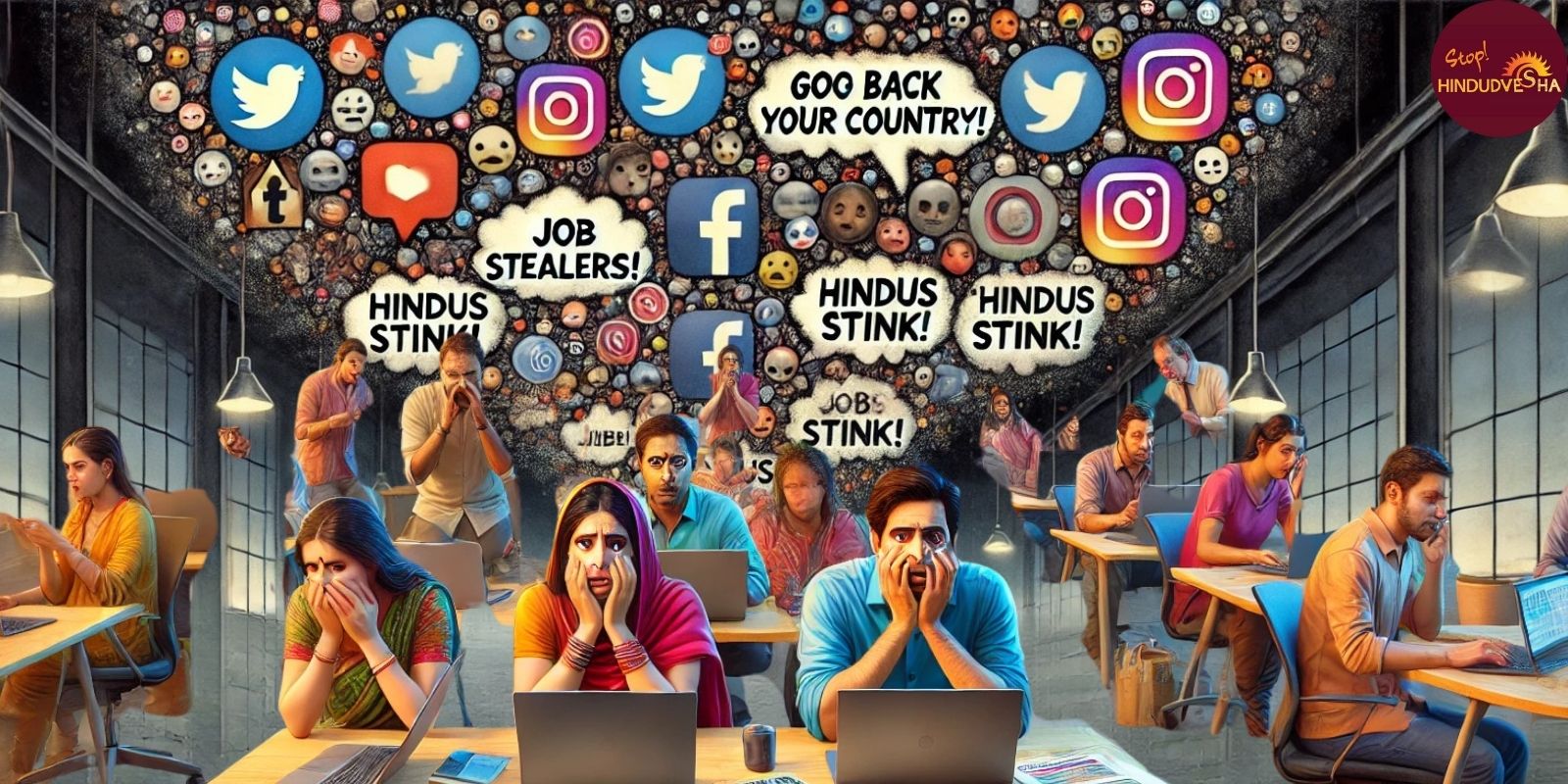
- Indian immigrants, especially in tech, face increasing racism in the West, fueled by misinformation and historical biases.
- Colonial-era stereotypes and missionary narratives have perpetuated negative views of India, reinforced by modern media and pop culture.
- Debates over H1B visas are exploited to paint Indian professionals as economic threats, amplifying xenophobia.
- Hidden power structures weaponize racial and political divides to limit India’s global influence and soft power.
- Indian communities must engage politically, promote cultural understanding, and challenge negative stereotypes to combat these narratives.
In November 2008 when India’s lunar probe Chandrayaan-1 landed on the moon, the headline at Fox News was: “Whoa! Where did they learn to do that?” Fox pulled the article after a few hours, no doubt after being called for its racist, patronizing jibe at Indians.
In 2013, when Nina Davuluri was crowned Miss America, the news was greeted with tweets that were explicitly racist, attacking Davuluri and circulating stereotypes about Indian Americans, Arab Americans, and other racial and ethnic minorities. The attacks on Davuluri’s Indian ethnicity and skin color were so pronounced that the tweets themselves became the object of media coverage. “I don’t understand how you can be up for Miss America. You’re not American. You’re a f***ing dot head!! #MERICA“[1]
Again, in October 2014, when India successfully put its Mangalyaan probe into orbit around Mars, the New York Times published a cartoon showing an Indian farmer with a cow knocking at the door of a room marked Elite Space Club where two white men sit reading a newspaper on “India’s Mars Mission.”[2]
Racism is not new to Indians who live in the West. They know the glass ceiling exists. Many have experienced passive-aggressive attacks on their country, religion, traditions, dietary habits, and customs. But even they were not prepared for the outpouring of visceral hatred directed their way on social media after an American far-right political activist and conspiracy theorist named Laura Loomer posted fake news that Sriram Krishnan – President Donald Trump’s Senior Policy Advisor for Artificial Intelligence – wants to remove limits on the number of Indians techies who could enter the US on H1B visas.[3]
Krishnan mentioned removing only country caps, which limit the number of green cards that can be issued to individuals from a particular country each year. Country caps disproportionately affect individuals from countries like India, China and the Philippines, which send large numbers of highly skilled workers to the US. Currently, every country is allocated the same number of green cards, no matter how many qualified applicants it has. As a result, applicants from India have an 11-year wait, whereas applicants from many other countries have no wait at all. So, while Indians account for around 73 percent of those holding H1-B visas for high-skilled workers, they are eligible for just 7 percent of green cards – the ceiling for any single country.[4]
But many Americans, misled by people like Loomer and other haters, were not interested in the facts. When Michigan Democrat Shri Thanedar posted that the US needs to streamline the H1B system to attract the best talent, he faced an avalanche of hate. Some of the comments are too gross to be reproduced here, but here are some of the printable ones:
“Can I buy you a ticket to Mumbai? One way, of course.” “Wow, you are a foreigner shilling for more of your compatriots to flood into my country and compete against my people? F**k you. You need to be denaturalized and deported.” “Go back to your own country and be innovative there.”[5]
“If Indians are so great, then why is India a giant pile of shit?”[6]
“Better a million illegal White immigrants than a hundred legal Indian immigrants.”[7]
“I think I would take a million more Mexicans in this country over 100,000 Indians.”[8]
“Indians stink,” said a Korean YouTuber named Matt Kim.[9]
Some Indian Christians – who believe that white Christians are favorably disposed towards brown Christians – also joined the party. A Hindu-hater named Anya Parambil threw in her two bits, lamenting “the growing influence of the Hindutva lobby in the U.S.,” Clearly envious at Hindu Americans being picked for key roles in the Donald Trump administration and therefore wanting to paint a target on the back of Hindus, she posted: “Pay attention to figures like Vivek and Tulsi. Hindutva is gaining power, and H-1B visas will surely be used to expand their base. Hindu nationalism is a dangerous movement that is antithetical to American values. They’re literally trying to make caste happen in Silicon Valley.”[10]
Another Christian convert named Elizabeth Abraham grabbed the opportunity to mock Hindus, conflating the achievements of Europeans as the success of brown Christians: “Yet Christians have won more than 600 Nobel Prizes. What have you done? Let’s see, dug under mosques to look for temples, spit & shit everywhere, worship your gods only on non-Hindu holidays, oppressed Dalits for thousands of centuries. Perpetual inferiority is all you have.”[11]
When Hindus pushed back, she doubled down on the hatred: “First get out of Christian country, garbage bag, unless they told you to come and clean their toilets there, garbage bag. Your ego needs to be on par with your actual station in life, not above. Now get out, and don’t come crawling back like the cockroach that you are.”[12]
Not even a major terror attack on American soil could interrupt the inquisition against Indians and Hindus. On January 1, 2025, Shamsud-Din Jabbar, an American citizen of Pakistani origin, rammed an F-150 pickup truck into a crowd in New Orleans, killing 14 people and injuring at least 35 others. But as quickly as the attack happened, the news disappeared from the media because Americans were busy attacking Indian techies.[13]
The racist attacks on social media have not yet spilled over into real-world violence, but Indian Americans are becoming increasingly concerned over their security and safety. “The recent social media attacks targeting Indian professionals and Indian Americans are deeply troubling. It’s time to step up and act,” said Rishi Kumar, Silicon Valley-based tech executive and executive board member of the California Democratic Party.[14]
Hinduphobia – Legacy of Colonialism
Millions of Americans have lost their manufacturing jobs to China over the past 40 years, and the US continues to bleed jobs to the communist nation. Most of these unfortunate workers are no longer employable as the industries they used to work in no longer exist in America. Tesla, for instance, has its giant ‘Giga Factory’ in Shanghai, which employs 20,000 people. Similarly, many European nations are seeing their manufacturing industries move to China. And yet, you don’t see Westerners hating Chinese people the way they do Indians. So why are Indians triggering such intense emotions among the online lynch mobs?
It’s important to recognize that the negative sentiment towards India is not a modern phenomenon. The seeds of this negativity were sown long before the advent of Twitter and Facebook. During the 19th century, when Swami Vivekananda visited the United States, he was subjected to questions like “Do Indian mothers throw their babies to crocodiles?” These were not random questions – they were part of a larger orchestrated campaign by Western missionaries and colonialists to portray India as a land of barbarism, superstition, and backwardness.[15]
British colonialism, in particular, left an indelible mark on how the world perceives India and its people, often painting a distorted picture. From 1858 to 1947, India was unfairly characterized as a land of backwardness and primitivism, in desperate need of Western “civilization.” This narrative was perpetuated through literature, media, and official reports, shaping the views of both British citizens and the global community.[16]
The portrayal of Hindus, who make up India’s majority population, was particularly negative. British colonialists, influenced by Christian missionary zeal, frequently misrepresented Hinduism by emphasizing practices like caste and superstition while disregarding its rich philosophical and spiritual traditions. They propagated a narrative of Hindu “inferiority,” focusing on social divisions and downplaying India’s historical achievements in fields like science, mathematics, and art. This skewed perspective was used to justify colonial rule, positioning the British as benevolent rulers and saviors.
Even after India achieved independence in 1947, the repercussions of this negative portrayal persisted. Stereotypes rooted in colonial narratives contributed to ongoing cultural misunderstandings. When America inherited the leadership of the Western world after Britain’s post-World War II economic and geopolitical collapse, the Americans also accepted the British views of India. Plus, after India became friends with the Soviet Union during the Cold War, the colonial stereotypes of the ‘Ugly Indian’ were dusted off and brought back into the American narrative.
While contemporary discussions challenge the depiction of India as chaotic and stagnant, the shadows of these colonial and post-colonial stereotypes continue to influence global perceptions of the country and its people. For instance, the character of Apu Nahasapeemapetilon from The Simpsons has significantly impacted the perception of Indians in the US by perpetuating negative stereotypes.[17] Apu, who self-identifies as Hindu, embodies exaggerated traits that many view as a form of “brownface,” reducing a diverse culture to simplistic caricatures. This portrayal has led to real-world consequences, including bullying and micro-aggressions faced by Indian-Americans, who often find themselves mocked for their heritage due to Apu’s influence. Pakistani-American actor Kumail Nanjiani says he experienced, more than once, a casting agent asking him to drop his real American accent to do an “Apu accent.”[18]
Such depictions hinder authentic representation and contribute to a narrow understanding of Indian identities in American society.
Deep State Machinations
To understand why social media has exploded in hatred against Indians, we must acknowledge the broader forces at play – specifically, the so-called “Deep State” elites who use both the left and the right as foot soldiers in their bid to maintain control over the world’s governments.
The Deep State, a term often used in political discourse, refers to a network of elites—often from the corporate, financial, and intelligence sectors—who exert power behind the scenes to shape global affairs. These elites don’t care for ideology. Whether it’s a left-wing progressive cause or right-wing conservatism, the Deep State uses whichever group serves its purpose at any given moment.
The tension between left and right has been strategically exacerbated by these elites to maintain a perpetual cycle of conflict, ensuring that both sides can be manipulated for various agendas. In the case of India and the H1B visa debate, the Deep State has seemingly amplified the narrative that Indians are a threat to the job market, particularly in the tech industry. This serves the purpose of fostering a climate of resentment towards Indian professionals, often pitting them against working-class Americans.
Weaponization of Racism Against India
One of the most disturbing aspects of this sentiment is that it doesn’t seem to be directed equally at other emerging powers like China, which is hollowing out the US economy, or Middle Eastern or African countries where religious extremists have killed thousands of Americans. This is because India’s rise presents a unique challenge to Western supremacy. Historically, India was a global center of civilization. From around 500 BCE, India led the world in mathematics, astronomy, philosophy, and trade. Civilizations like Greece, Rome, and Mesopotamia absorbed Indian knowledge and culture, contributing to the spread of Indian ideas worldwide.
India’s impact was so profound that regions like Southeast Asia, including modern-day Cambodia, Vietnam, Indonesia, and Laos, became heavily influenced by Indian philosophy, culture, and religion. The legacy of India’s global influence can still be seen today in the widespread practice of yoga, the reverence for Hindu philosophy, and the global recognition of Indian intellectual thought. In many ways, India was the America of the ancient world, a place of intellectual and cultural magnetism that drew people from all corners of the globe.
Given this history, it’s not difficult to see why Western elites would fear India’s resurgence. The West has spent centuries constructing a narrative of its own cultural and intellectual superiority. The rise of India as a global power directly challenges that narrative. It’s not just a political or economic threat – it’s a direct challenge to the very core of the Western elite’s historical self-image.
While some of the animosity towards Indian immigrants may be organic, the Deep State has amplified this sentiment in a very calculated way. They are using the current political environment, particularly within the MAGA (Make America Great Again) movement, to create divisions. Indians – many of whom are highly educated, skilled professionals – are being painted as the enemy in a zero-sum game where American workers must fight for limited job opportunities.
Even far-left characters are allies in the war against Indians. For instance, Democratic Party leader Bernie Sanders jumped into the H1B debate, describing Indians as undesirable indentured servants: “The main function of the H-1B visa program is not to hire ‘the best and the brightest,’ but rather to replace good-paying American jobs with low-wage indentured servants from abroad. The cheaper the labor they hire, the more money the billionaires make.”[19]
This narrative feeds into broader racial anxieties and fears, which are then magnified by social media platforms. The goal? To limit India’s soft power and influence in the West by portraying Indians as economic threats, thereby preventing further integration and success of Indian professionals in the US and other Western nations.
Diminishing India’s Influence
At the heart of this anti-India propaganda is the strategic goal of diminishing India’s influence and soft power. The Deep State elites want to prevent India from gaining any more global traction, particularly in the realms of technology, business, and geopolitics. The H1B visa controversy is just one example of how this propaganda is being used to incite fear and resentment towards Indian professionals. By framing them as job-stealers or economic invaders, the Deep State works to sow division between Indian immigrants and American citizens. By cultivating and amplifying racism and negative stereotypes about India, these elites hope to slow or reverse India’s ascent on the global stage.
Awareness and Education
Among all ethnic groups, Indians tend to be the least organized when it comes to political issues. They are great at landing up at Diwali, Onam, and Christmas galas, but their turnout at political and community events is low. Many Indians are proudly apolitical. But unfortunately for you, if you don’t go into politics, politics will come for you. It is, therefore, crucial for Indians to recognize and challenge the narratives pushed by the media and social platforms. By understanding the long-standing history of anti-India propaganda, Indians can be in the space to effectively resist these efforts and promote a more accurate understanding of India’s role in the world. While combating negative perceptions can be challenging, there are several strategies Indian immigrants can adopt:
- Community Engagement: Actively participating in local community events and volunteering can help break down stereotypes and build positive relationships with locals.
- Cultural Exchange: Organizing cultural events, festivals, and workshops can showcase India’s rich heritage and traditions, fostering mutual respect and understanding. Chinese immigrants excel at this.
- Education and Awareness: Educating others about the contributions of Indian immigrants to society, including their professional achievements and cultural contributions, can help counter negative narratives.
- Media Representation: Encouraging and supporting positive representation of Indian immigrants in media and entertainment can help challenge and change negative stereotypes.
- Political Advocacy: Engaging with local politicians and policymakers to address issues of discrimination and promote inclusive policies can help create a more welcoming environment.
- Building Alliances: Forming alliances with other immigrant and minority groups can create a stronger, united front against discrimination and negative perceptions.
It’s important to remember that change takes time and persistence. By working together and staying committed to these efforts, Indian immigrants can help improve their image and create a more inclusive society.
Citations
[1] A War Of Tweets Erupts Over Latest Miss America (NPR); https://www.npr.org/sections/codeswitch/2013/09/16/223149807/a-war-of-tweets-erupts-over-latest-miss-america
[2] India Mars Mission: New York Times apologises for cartoon (BBC News); https://www.bbc.com/news/world-asia-india-29502062
[3] Deeply disturbing to see the appointment of Sriram Krishnan; @sriramk as Senior Policy Advisor for AI at the Office of Science and Technology Policy (Laura Loomer on X); https://x.com/LauraLoomer/status/1871262423950520454
[4] Trump years were better for Indian H1B and citizenship applicants (MC Analysis); https://www.moneycontrol.com/news/business/economy/trump-years-were-better-for-indian-h-1b-and-citizenship-applicants-mc-analysis-12898953.html
[5] MAGA fury over H1B scortches even Indian Americans Republicans (Times of India); https://timesofindia.indiatimes.com/world/us/maga-fury-over-h-1b-scorches-even-indian-american-republicans/articleshow/116771147.cms
[6] If Indians are so great then why is India a giant pile of shit? (NextWaveAmerican on X); https://x.com/NextWaveAmerica/status/1872427974827639267
[7] Better a million illegal White immigrants than a hundred legal Indian immigrants (Apolitical on X); https://x.com/Apolitical3678/status/1873143270253170961
[8] I think I would take a million more Mexicans in this country over 100,000 Indians (Jo on X); https://x.com/junker_jo/status/1872477703150145544
[9] Why the Indian H-1B Visa MAGA Fight is HEATED – Matt Kim, a Korean American; https://www.youtube.com/watch?v=25RyxRP7sck
[10] Since the debate over H-1B visas is trending, I think it’s a good time to share @andrewmcockburn ’s deep dive on the growing influence of the Hindutva lobby in the U.S.( Anya Parampil on X); https://x.com/anyaparampil/status/1872341275027878061
[11] Yet Christians have won more than 600 Nobel Prizes. What have you done? Let’s see, dug under mosques to look for temples, spit & shit everywhere, worship your gods only on non-Hindu holidays, oppressed dalits for thousands of centuries. Perpetual inferiority is all you have (Elizabeth Abraham on X); https://x.com/serial__comma/status/1873078353089200442
[12] First get out of christian country, garbage bag. Unless they told you to come and clean their toilets there, garbage bag (Elizabeth Abraham on X); https://x.com/serial__comma/status/1873851929883013423
[13] First get out of christian country, garbage bag. Unless they told you to come and clean their toilets there, garbage bag. (Hindudtan Times); https://www.hindustantimes.com/world-news/new-orleans-attack-bomb-materials-at-home-shamsud-din-jabbar-was-preparing-for-weeks-what-fbi-found-so-far-101735952927199.html
[14] Reeling under recent social media attacks, Indian Americans feel need for strickter enforcement mechanism against hate speech and racist rhetoric (Times of India); https://timesofindia.indiatimes.com/nri/us-canada-news/reeling-under-recent-social-media-attacks-indian-americans-feel-need-for-stricter-enforcement-mechanisms-against-hate-speech-and-racist-rhetoric/articleshow/116853175.cms
[15] Heathen Mothers, their Babies, and Crocodiles (Vivekananda Abroad A postcard pilgrimage); https://vivekanandaabroad.blogspot.com/2024/01/
[16] The Implications of British Colonial Domination on the Indian Cultural Ethos (Perception Publishing); https://www.redalyc.org/journal/7038/703873561013/html/
[17] The problem with Apu: why we need better portrayals of people of colour on television (The Conversation); https://theconversation.com/the-problem-with-apu-why-we-need-better-portrayals-of-people-of-colour-on-television-106707
[18] Let’s Talk About the Apu Accent (Vulture); https://www.vulture.com/2015/11/master-of-none-recap-season-1-episode-4.html
[19] Sanders calls for H-1B visa reform: ‘Elon Musk is wrong’ (The Hill); https://thehill.com/policy/technology/5064132-sanders-criticizes-musk-h1b-visa/

Donate to HINDUDVESHA
Our Mission is to explore and expose Hindudvesha through research analysis, education and response.
SUPPORT US