

From Hindu Dharma to Christianity and Back: Esther Dhanraj’s Remarkable Journey
 Dr. Jai G. Bansal · 09/30/2024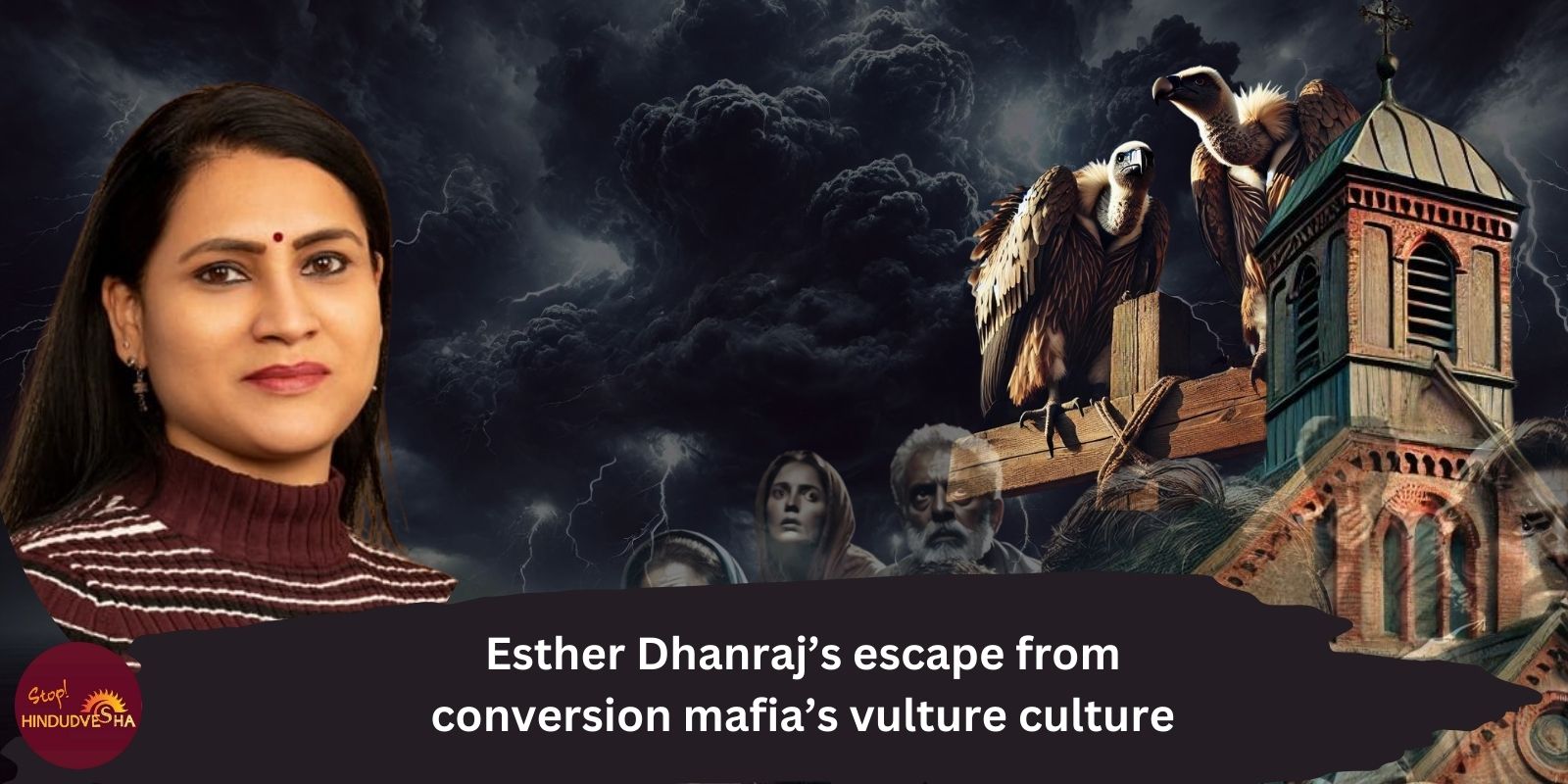
- Esther Dhanraj grew up in a large, conservative Hindu family with deep-rooted religious practices, including daily rituals and grand festival celebrations.
- During a challenging period for her family, Christian neighbors and pastors began visiting, offering prayers and support, which led to the family’s gradual conversion to Christianity.
- Despite the initial belief that Christianity could coexist with their Hindu practices, the family faced pressure to abandon Hindu rituals and symbols, leading to significant cultural and religious shifts.
- Esther’s journey back to Hinduism was gradual, influenced by her disillusionment with Christianity and a deeper connection with Hindu philosophical concepts like karma and dharma.
- Esther emphasizes the importance of educating children about Hinduism and the tactics used in religious conversions, advocating for a comprehensive approach that includes both religious teachings and awareness of cultural preservation.
Esther Dhanraj, also known as Kamakshi, is a staunch upholder of Sanatana Dharma. With a Master’s degree in English Literature from Osmania University, India, and a research-focused Master’s degree in Christian Studies, specializing in Apologetics, from Luther Rice University, Georgia, she has delved deeply into Christian doctrines and practices. Initially a devout follower of dogmatic teachings, Esther liberated herself from superstitions by subjecting her faith to academic scrutiny. Recognizing the importance of academic inquiry in religious understanding and practice, she now focuses on raising awareness about it. Esther actively supports grassroots initiatives aimed at educating rural communities about Sanatana Dharma and mentors leadership teams of various organizations involved in similar efforts. Currently serving as the Director of Community Outreach at the Hindu University of America, Esther brings her rich experience working with volunteer groups, leveraging her rhetorical abilities to mobilize funds for dharmic causes and her academic expertise in religious research and writing to advance her mission.
This write-up is based on her interview on our Dharma Explorers platform. The complete video recording of the interview can be accessed here.
You have a very interesting life story. Can you share details about your growing-up years, including your family environment and the influences that shaped your worldview? Additionally, how did you come to embrace the Christian faith, and what has your journey been like since then?
I am grateful for the opportunity to share my story with you and your viewers. It is always a pleasure to reflect on my journey. I do so not with regret but as a unique life experience that few people have.
I grew up in a large, conservative Hindu family in an urban area. I lived with my parents, four siblings, two cousins who were adopted by my parents, my maternal grandmother, and our dog. My father was deeply involved in religious activities, and my mother, too, had her daily rituals. My grandmother was a significant influence, teaching us traditional practices like the Surya Namaskar and the performance of pujas during festivals. These teachings were so ingrained in me that even when I later became a devout Christian, I struggled to suppress them from my subconscious, as they were considered forbidden.
Our home was filled with religious symbols and rituals. We had a puja room complete with a large shrine. My father performed rituals regularly, and the house often smelled of camphor from these ceremonies. My grandmother practiced Ayurveda, so we rarely saw doctors; she made herbal concoctions and ointments that took care of our health. Festivals were grand events with elaborate decorations and rituals that brought our family together in celebration.
Despite the richness of our Hindu rituals, our understanding of Hinduism was superficial. It was mostly about the festivals and the customs rather than the deeper philosophical teachings. Festivals like Holi and Diwali were celebrated extensively, but we did not delve into the deeper aspects of Hindu philosophy.
When I was about twelve years old, my family was introduced to Christianity. My family went through a rough period where we faced significant challenges. My mother fell slightly ill, and my father lost his well-paying job. During this vulnerable time, a Christian neighbor convinced my parents that our hardships were a sign that the Christian God had chosen our family for salvation. This marked the beginning of our journey into Christianity.
After my mother’s surgery in Hyderabad, we moved from Odisha to Hyderabad. In Hyderabad, Christianity was much more prevalent compared to Odisha. There were many churches, and Christian communities were active and widespread. When we first arrived, we stayed with my aunt, who remained a devout Hindu throughout her life. It is a testament to her tolerance and respect for other religions that she never objected when Christian pastors began visiting her home to pray and share their faith.
Seeing our vulnerability, these pastors saw an opportunity. They started holding weekly prayer meetings for our family. The neighbor from Odisha, who had initially introduced us to Christianity, continued to visit us in Hyderabad, making significant efforts to ensure we stayed on this new path. His dedication was remarkable, considering he was just a middle-class engineer.
It is interesting that, while living in Hyderabad, you had local church people visiting and praying for you, as well as your neighbor from Odisha. It seems like there was a coordinated network working to bring your family into their fold, correct?
Interestingly, these evangelists didn’t know each other before meeting our family, yet they formed an unwritten arrangement.
There was definitely a network at play. The person from Odisha was just a lay evangelist, not a career evangelist or pastor, unlike the church pastor in Hyderabad. Interestingly, these evangelists didn’t know each other before meeting our family, yet they formed an unwritten arrangement. The one from Odisha would visit every few months, while the local church members visited weekly. Together, they coordinated their efforts to bring our family into their faith community.
You mentioned that your family was very devout, practicing various Hindu rituals and celebrating many festivals. Despite this, it seems they became vulnerable to conversion tactics. Was there something deeper going on, such as doubts about Hinduism within your family, or was it more about being in a difficult financial and physical situation that made you more open to their tactics?
Hindus are generally very welcoming and respectful towards other religions. For example, my aunt never told pastors not to visit or pray for her family. Whenever a pastor visited the neighborhood, including Hindu homes, he would say a prayer, read a Bible verse, and give a short sermon. Our family never objected to these visits. This attitude reflects the broader Hindu mindset of respecting all faiths.
…the reality of conversion came as a shock to my father. He was told he could no longer worship his Hindu deities..
My parents viewed conversion to Christianity as an addition to their existing faith rather than a replacement. This perspective was typical of the middle-class, urban Hindu mindset at the time. Despite our strong roots in Hindu rituals and festivals, they didn’t initially see conversion as a significant change. They thought it merely meant adding another deity to their worship practices.
However, the reality of conversion came as a shock to my father. He was told he could no longer worship his Hindu deities, which was difficult for him to accept. Interestingly, my grandmother remained a Hindu until she passed away about nine years after my parents’ conversion. My father was firm in telling the pastors that they had no right to object to my grandmother’s beliefs, and he ensured that her puja room remained untouched as long as she was alive. This meant that, in our home, two religions were practiced simultaneously.
Can you explain the conversion process in greater detail? How did a person from Odisha end up influencing your family in Hyderabad? Were they from the same denomination? What changes occurred in your household after the conversion?
The transition to Christianity in our family was very slow and smooth. Despite the conversion, our food habits did not change. My parents, my siblings, and I all remained vegetarians, not even eating eggs. This was very particular for us, especially because my grandmother, who was widowed early in her life, managed the kitchen without using even garlic or onions. When my mother took over, she allowed these ingredients since she was raising a large family. Our family always believed in the concept of food as medicine, which my mother passed on to me and my siblings, making us very conscious about what we ate.
Our puja room remained in the house, and we continued to follow the Hindu lunar calendar for personal matters. Officially, we might have acknowledged Christian holidays, but in our hearts and daily lives, the Hindu traditions stayed strong. This kind of confusion is not uncommon among Christians in India today. Many converts still cling to their old practices out of habit or fear. They might check the Hindu calendar (panchang) for auspicious days, follow Vastu guidelines, and incorporate Hindu rituals into their Christian ceremonies. Often, the only noticeable difference might be the absence of a bindi or kumkum and various symbols of Hindu dharma at home.
In my family, the changes did not happen all at once. My mother, for instance, continued wearing her bindi for a long time. She did this initially for my grandmother, who could not bear to see her daughter without one. My mother often argued with the pastors, asking them to show her where in the Bible it said she couldn’t wear a bindi. They couldn’t provide any specific passages, so she kept wearing it, believing that if God truly forbade it, it would be clearly stated in the scriptures.
However, there was a point when I pressured my mother to remove her bindi. My father was in the hospital, critically ill, and my mother called me in distress when the doctors had given up hope. I suggested that perhaps God wanted to draw her closer and that the bindi might be a barrier between her and God. This conversation took place over the phone while I was in Hyderabad and they were in Visakhapatnam. By this time, I was a fervent Christian, almost blindly so. Under my pressure, she eventually removed her bindi, but up until the early 2000s, she had kept it.
Other than this, not many changes were forced upon us. My parents attended church events, but they always left before the meals were served to avoid seeing non-vegetarian food being served, much less eating it. Surprisingly, the pastors respected this choice and did not pressure my parents to partake in these meals or any activities against their will. This was fortunate for us, as not all families had the same experience. In many villages, new Hindu converts to Christianity might not have had the strength or voice to resist such pressures.
There were a few significant changes, though. My father had to remove his sacred thread (janeu), and my mother had to stop worshipping the Hindu deities. These were the major alterations to our religious practices.
Regarding the influence from Odisha, the person who played a crucial role in our conversion was not a professional evangelist or pastor but a lay evangelist. Despite not being from the same denomination as the church in Hyderabad, they worked in an unspoken agreement. The lay evangelist from Odisha would visit us every few months, while the local church members in Hyderabad visited weekly. Together, they formed a coordinated effort to bring our family into the Christian fold.
This network of influence was quite powerful. The lay evangelist from Odisha initially reached out to us during a difficult time in our lives: my mother was ill, and my father had lost his job. This created an opportunity for them to offer support and slowly introduce us to Christianity. Our vulnerability made us more open to their visits and prayers.
Do you believe that children, particularly the second generation, are more indoctrinated during the conversion process than the first generation? Is this slow targeting an intentional part of their process?
The second generation is definitely more indoctrinated than the first. While the first generation is transitioning, the second generation is raised entirely within the new faith. They go to Sunday school and youth groups, experiencing all the phases of a Christian life. This was the case for me. Since I was introduced to Christianity at a young age, I didn’t miss any phases except for the Sunday School phase, which is for children under 13 years old.
The church operates like a tight-knit organization, focusing on families rather than individuals. Luring teenagers is much easier for pastors than targeting adults.
The church operates like a tight-knit organization, focusing on families rather than individuals. Luring teenagers is much easier for pastors than targeting adults. Teenagers are always searching for a sense of belonging and trying to establish their own identities separate from their families. I was in that vulnerable stage when these influences began.
The lay evangelist from Odisha and his wife made bi-monthly or quarterly visits to our home from Chennai. They would stay for 15 to 20 days and organize prayer sessions, significantly influencing my conversion process. They claimed to have supernatural abilities that Christianity calls spiritual gifts or gifts of the holy spirit, with the woman supposedly having the gift of prophecy. During prayer sessions, she would utter what they called “tongues”—incomprehensible gibberish—and her husband would interpret it into English since we didn’t speak Tamil and they didn’t speak Telugu.
During these sessions, she claimed that God had a great plan for me and wanted to give me the spiritual gifts of healing. At 13, the idea that I could have the power to heal was incredibly alluring. They said that if I followed Christian practices—going to church, reading the Bible, becoming a Christian—I would gain these powers.
Their influence extended beyond prayer sessions. At church, I witnessed pastors supposedly healing people with a touch, a common practice in Pentecostal churches, an evangelical denomination of Christianity. Seeing these acts made me aspire to have similar abilities. This desire for power and belonging is what drew me deeper into Christianity.
It seems like there’s a well-organized playbook to exploit people’s vulnerabilities to slowly bring them into the fold. Did you change your name when you became a Christian?
Everyone is given a Christian name at baptism. However, many people don’t officially change their names because the process is cumbersome. I actually kept my original name until I got married. It was during my marriage that my in-laws suggested I take on the name Esther. As a result, my wedding certificate and all related documents were changed to reflect this new name.
While you were practicing Christianity, did you actively participate in proselytizing? What methods did you use, and what were your responsibilities beyond identifying as a Christian?
In Christianity, there are two types of evangelists: career evangelists and lay evangelists. Regardless of age or profession, every Christian is essentially a lay evangelist. This role applies to Christians in various settings, such as college campuses, neighborhoods, workplaces, or as homemakers. Every Christian is expected to share the gospel, which means spreading the message of Christianity, particularly to non-Christians, with a focus on Hindus. They typically avoid targeting Muslims.
As a Christian, my primary duty was to share the gospel with any Hindu I encountered, especially if they were going through a difficult situation. This sense of duty intensified during times of hardship, as it was believed that Jesus could solve all their problems if they embraced Christianity. My responsibility was to approach vulnerable Hindus and talk about Jesus, encouraging them to attend church and follow Christian teachings.
There was no formal quota or target for conversions. However, the church environment created an implicit pressure to bring new converts
There was no formal quota or target for conversions. However, the church environment created an implicit pressure to bring new converts. Seeing fellow Christians bring in Hindu friends or families reinforced this pressure. Sermons subtly conveyed that loving your Hindu neighbors or relatives meant saving them from eternal damnation by converting them to Christianity.
My family’s conversion was considered a significant achievement for the church. As an urban, educated, middle-class family, our conversion served as a trophy for the church. They often presented us as an example to other potential converts, implying that if a family like ours could convert, anyone could.
Thus, while my parents did not actively proselytize, their lifestyle changes influenced others. They became models for the church community, demonstrating how conversion to Christianity could transform a family’s life.
I, on the other hand, did actively participate in proselytizing. Although I never explicitly told anyone to abandon their Hindu faith or deities, my actions and the way I lived my life as a devout Christian influenced others. People saw the changes in me, and some were inspired to explore Christianity themselves.
Reflecting on my journey, I can see how the church’s tactics are designed to integrate new converts fully into the Christian community. This process involves not only a change in religious practices but also a deep immersion into the church’s social and support networks. For a teenager like me, seeking belonging and identity, these influences were particularly strong.
Did you or your parents ever regret converting to Christianity? How did you view your life before and after the conversion during this period?
There are two parts to this question: my parents’ regret and my own. Personally, I did not regret converting to Christianity during those 25 years. It was only after I left Christianity that I felt a deep sense of regret. I felt that I had wasted 25 years of my life investing in and understanding a book that I later believed to be false.
As for my parents, my father, in particular, had significant regrets about the conversion. We had a deep and revealing conversation when he was on his deathbed. I had traveled from the US to India to see him after my siblings informed me that his condition was critical. During those final days, I was able to spend most of my time with him, as my siblings were busy with their own responsibilities.
When my father removed his sacred thread (janeu), his own mother, who was ill in Visakhapatnam, wanted to see him one last time. The pastors, however, discouraged him from visiting her….They instilled fear in him, suggesting that such actions would have negative spiritual consequences for the family.
Despite being on oxygen and struggling to speak, my father shared many thoughts and questions about the choices he had made. One poignant moment was his reflection on a specific event shortly after their conversion. When my father removed his sacred thread (janeu), his own mother, who was ill in Visakhapatnam, wanted to see him one last time. The pastors, however, discouraged him from visiting her. They argued that if he went, he might be pressured to participate in Hindu rituals and wear his janeu again, which he had just removed. They instilled fear in him, suggesting that such actions would have negative spiritual consequences for the family.
My father, already dealing with the challenges of supporting a large family, was swayed by their arguments. Consequently, he did not visit his mother or attend her last rites. This decision haunted him for the rest of his life. He rarely spoke about it, but during our final conversation, he expressed his deep regret and sadness over this choice. It became clear to me that he had lived with this regret for many years.
My mother’s experience was different. She developed Alzheimer’s in her later years, and by the time she reached the last stage of her life, she no longer remembered her conversion or her identity as a Christian. She passed away last November, unaware of her past religious journey. However, during the years when she was still cognizant, I don’t believe she regretted converting in the same way my father did. Yet, she definitely missed aspects of being a Hindu. There were times when I could sense her longing for the traditions and rituals she had left behind.
Reflecting on my own journey, I can see that my immersion in Christianity was deep and comprehensive. I became a lay evangelist tasked with spreading the gospel to non-Christians, particularly Hindus. The church environment fostered a sense of responsibility to convert others, emphasizing the belief that Christians must save their non-Christian friends and neighbors from eternal damnation. Of course, as I mentioned, none of my efforts amounted to active proselytization. However, I was confident and mindful of the fact that the way I conducted myself as a Christian, my spiritual practices, and my economic status were an example for non-Christians to model after.
What was your attitude towards non-Christians during this phase? Did you cut your ties to them?
No, we were not expected to cut off ties with our Hindu family and friends. In fact, we were encouraged to maintain these relationships. The idea was to stay connected and look for vulnerable moments in their lives to preach the gospel and try to convert them. So, keeping in touch with them was actually an important part of the process.
What were you thinking about non-Christians during this phase? Did you consider them as misguided or simply as people living their lives differently?
During this phase, my perspective towards non-Christians was predominantly one of pity and concern. I genuinely believed that they were missing out on the profound truth and immense love that Jesus offered. The notion that they were unaware of the divine plans and blessings that the Christian God had in store for them troubled me deeply. I was convinced that these individuals were on a path to eternal damnation, suffering the torments of hell for their lack of belief.
During this phase, my perspective towards non-Christians was predominantly one of pity and concern. I genuinely believed that they were missing out on the profound truth and immense love that Jesus offered.
I perceived their resistance to the gospel message as a manifestation of Satan’s influence, actively preventing them from embracing the truth. This belief was reinforced by the idea that Satan was blinding their minds and hardening their hearts against the Christian doctrine. Consequently, I felt a strong sense of responsibility to intervene and guide them towards salvation.
When I invited friends and acquaintances to church events, such as women’s conferences, family gatherings, or children’s summer camps, I experienced a mix of hope and despair. While many would accept the invitation and attend these events, there were always a few who declined. For those who refused, I felt a profound sadness and a heightened sense of urgency. I would fervently pray for them, asking God to soften their hearts and thwart Satan’s efforts to keep them away from the church.
This mindset was not isolated to me alone. My siblings and Christian friends shared similar sentiments. They continued to pray earnestly for those who resisted, including me, after I left Christianity. Their prayers were aimed at bringing individuals back to what they considered the “right path,” illustrating the pervasive and enduring nature of this belief system within our community.
How did your Hindu friends and social circle from school and college react to your conversion to Christianity?
My Hindu friends and family were very tolerant and respectful of my conversion. Hindus, in general, are known for their respect towards other religions, and my personal experience was no different. My cousins and extended family, who were deeply rooted in Hindu traditions, were very welcoming and did not reject us despite our conversion.
For instance, my mother’s side of the family, including my aunts, never objected to pastors visiting our home for prayers. Even after our conversion to Christianity, they continued to include us in their celebrations and rituals. We were still invited to partake in festivals like Sankranti, Diwali, Ganesh Puja, and Navaratri. My siblings and I would attend these events, although we respectfully requested not to be served prasad.
In fact, my Hindu relatives would sometimes join us in our prayer meetings. Even after they got married and moved out, they would come back to attend these gatherings. This mutual respect and acceptance allowed us to maintain close ties with our Hindu family and friends despite their religious differences.
Could you explain the fear factors they instilled, like not praying to other gods and removing Hindu symbols like janeu or bindi? Were there any SOPs or promised advantages for new converts? Does your family still practice Christianity?
Regarding the fear factor, the pastors emphasized that praying to any other gods or participating in Hindu rituals would jeopardize our spiritual well-being and standing with God. For example, they insisted on the removal of the janeu, associating it with idolatry and spiritual impurity. This created a sense of fear that maintaining any Hindu practices would bring divine disfavor or spiritual harm.
… the pastors emphasized that praying to any other gods or participating in Hindu rituals would jeopardize our spiritual well-being and standing with God.
New converts were not given formal SOPs but were guided informally through sermons and personal interactions with church leaders. They promised spiritual benefits like salvation, peace, and divine protection. Additionally, they offered a supportive community, which can be a significant advantage for someone feeling isolated or going through tough times.
My family’s current religious practices are varied. While some of my siblings remain devout Christians, I have returned to my Hindu roots. This process of rediscovery and reconciliation with my heritage has been deeply personal and transformative.
You mentioned fear factors, but what are the positive incentives they provide to new converts?
There’s a common misconception that conversions are solely motivated by material incentives, such as the term “rice bag converts.” I’ve often been asked if devout Hindus, like my parents, converted simply for material gain. The reality is far more complex.
When a family is vulnerable, experiencing crises or hardships, they become susceptible to external influences. In such times, they are surrounded by what I call “predators” — individuals who are laying in wait to “pounce” on you and offer solutions through conversion. The church’s approach involves isolating the family and creating an environment where they feel continuously supported and valued.
The church leverages several tactics to make new converts feel welcomed and included. Initially, the family is invited to church services, where they experience a sense of community. Each member of the church makes it a point to personally greet and support the new converts, sharing stories of how Jesus helped them through their struggles. This immediate acceptance and sense of belonging can be incredibly powerful for people in distress.
Throughout the week, between Sunday services, the church maintains contact. Christian families visit the new converts’ homes, offering prayers and companionship. This constant presence reassures the converts that they are not alone. Weekly prayer meetings at their home reinforce the message that the Christian community is there to support them continuously.
The message conveyed to new converts is not just about material help or miraculous cures. It’s about emotional and spiritual support. Church members often tell new converts that Jesus has a great plan for them and that their conversion is a divine choice. They are told that out of all the people in the world, God chose them for a special purpose. This idea of predestination—that their conversion was part of God’s plan even before the creation of the world—is a powerful enticement.
It’s important to understand that the church’s support network is incredibly strong. New converts are never left alone. Whether their situation improves or not, the continuous involvement of the church community helps maintain their new religious identity. This comprehensive support system is a stark contrast to the more individualistic approach often found in other religious communities.
Moreover, the emotional support offered by the church can be incredibly enticing. Converts are told that Jesus will alleviate their suffering and that the church community will stand by them through all challenges. This promise of unwavering support can be a major factor in why families remain Christian, even if their immediate problems are not solved.
The church’s ecosystem is designed to retain converts through a combination of spiritual promises, community support, and psychological reinforcement.
Reflecting on my own family’s experience, the transition to Christianity wasn’t just about material incentives. It was about finding a community that offered constant support and reassurance. The sense of belonging and the promise of divine intervention played a significant role in our conversion.
My parents’ fear of returning to their previous faith and the emotional and psychological support provided by the church made it difficult for them to reconsider their decision. The church’s ecosystem is designed to retain converts through a combination of spiritual promises, community support, and psychological reinforcement.
A homecoming like yours is a rare occurrence. What prompted you to return to your roots?
The return was a gradual process. It wasn’t an overnight transformation where I went to bed a Christian and woke up a Hindu. The journey began when I was in the US and decided that Christianity was not what I thought it was. Initially, I explored atheism, reading many books written by former Christians. However, atheism did not answer all my questions. I realized that while I didn’t believe in the Christian God, I couldn’t dismiss the existence of a higher power altogether. This led me to identify as agnostic, acknowledging some higher power but unsure of its nature.
Agnosticism, however, didn’t feel right either. Deep down, my cultural and spiritual DNA was Hindu. For someone with no prior Hindu background, atheism or agnosticism might seem like the only worldviews available, but for me, Hinduism remained a significant part of my identity. I have always respected the ancient wisdom of Hindu sages and seers, acknowledging the value of their teachings.
One concept that drew me towards Hinduism was the law of karma. In Christianity, there is no concept of karma or past lives; there is only one life, and its purpose is to decide one’s eternal fate based on faith in Jesus.
With this intrinsic respect for my ancestral faith, I started exploring Hinduism again. The open-mindedness that led me to question Christianity also led me to delve into Hindu literature. One concept that drew me towards Hinduism was the law of karma. In Christianity, there is no concept of karma or past lives; there is only one life, and its purpose is to decide one’s eternal fate based on faith in Jesus. Actions in Christianity have no bearing on one’s afterlife; only faith determines whether one goes to heaven or hell.
This deterministic view did not sit well with me, especially as I began to understand the concept of karma in Hinduism. Karma posits that every action has consequences, not only in this life but in future lives as well. This idea resonated with me deeply because it aligned more closely with my sense of justice and morality. The notion that our actions matter and that we are accountable for them in a broader, more enduring context appealed to me.
As I explored further, the concept of dharma also intrigued me. Dharma, the moral order of the universe, provides a framework for living a righteous life. Understanding dharma is a complex and ongoing process, but it gave me a sense of purpose and direction that was missing in my previous faith.
Returning to Hinduism was not just about rejecting Christianity but about finding a belief system that answered my longstanding questions. Hinduism offered a philosophical depth and a moral framework that resonated with my experiences and observations of life. The Hindu concepts of karma and dharma provided a comprehensive understanding of life, actions, and morality that resonated with me. This journey of rediscovery has been deeply personal and transformative, allowing me to reconcile my past with my present and find peace in my cultural and spiritual heritage.
What kind of resistance did you face from the church, your family, or others when you decided to leave Christianity? How did you feel during that challenging time?
The church couldn’t do much about my decision. However, they were not pleased. When I left India, I was a practicing Christian and even joined a seminary in the United States, which initially made my church very happy. They saw it as an opportunity for me to further the work of Christianity and bring more converts, particularly Hindus, into the faith.
However, when they found out I had quit Christianity, their attitude changed. The church I left was a megachurch with about 10,000 weekly attendees. They were disappointed and likely felt betrayed, but ultimately, it was not their decision to make.
Regarding my family, there were two sides to consider. I married a Christian, a third-generation one at that. Fortunately for me, my husband had always questioned the teachings of Christianity, even from a young age. He found the doctrines and stories, such as the creation story and the concept of original sin involving a talking snake, to be nonsensical. These early doubts led him to reject the core tenets of Christianity, although he continued to attend church out of habit and familial expectations. However, he never truly believed in the doctrines or teachings of Christianity. He did not believe that Jesus was the only God or had the power to take people to heaven.
I feel fortunate that my husband had this perspective. However, I often wondered why he never brought up his doubts about Jesus being God or initiated a conversation about his disbelief. Why did he remain silent and not stop me from being a fanatic, fundamentalist Christian for almost 25 years? His answer was simple: “You were not doing anything wrong, and if it brought peace to us, who was I to deny or discourage you from that path?”
Regarding the rest of my family, my siblings are still upset. They don’t bother me, though I know they’re not happy with my decisions. I’ve greatly disappointed them, especially since I was once someone who guided them in their Christian faith—helping them interpret the Bible, praying with and for them, and teaching them how to pray. For someone like me to reject Christianity and speak against it publicly is understandably disappointing for them. However, we don’t cross each other’s lines. We politely greet each other on occasions like weddings, anniversaries, and birthdays. They don’t know my thoughts about them, and I don’t know theirs about me, which seems to be a good balance. I owe a lot to my husband for maintaining this peace.
My departure from Christianity was unique, given the firm hold the religion typically has on its followers. Many people who leave Christianity do so quietly, fearing backlash from the church or their families. They face significant resistance and often remain closeted ex-Christians. In my case, the transition was smoother, possibly due to good karma, allowing me to share my journey openly today.
Emotionally, the transition was complex. Leaving behind a faith that had been a significant part of my life for so long was challenging. There was a sense of betrayal and loss but also a profound realization that I needed to find a belief system that resonated with my true self.
Given your unique experience, what advice would you give to young parents about keeping their children grounded in Hinduism?
I have a lot to say to Hindu parents, especially about how to keep our children rooted in Hinduism. Many parents believe that educating their children in shastra (scriptures) is sufficient. They take their kids to temples, expose them to the Bhagavad Gita, and make them memorize shlokas. The children recite these shlokas on stage, and the parents feel proud, thinking their duty as Hindu parents is done. However, shastra alone is not enough. There must also be shatru-bodh (awareness of the enemy or understanding the adversary).
The church often opposes development projects in rural areas because it prefers economically disadvantaged people who are easier to convert through offers of material benefits.
Christian conversion is not merely about replacing Hindu deities with Jesus. The church often opposes development projects in rural areas because it prefers economically disadvantaged people who are easier to convert through offers of material benefits. By keeping these communities underdeveloped, it can offer freebies, which are not actually free, to lure people into conversion.
This tactic makes conversion to Christianity more than just a change of faith. It can be seen as a threat to national security, especially in regions like the Northeast and border states like Punjab, where conversions are significant. The cultural and national identity of these areas is at risk, making it essential for Hindu parents to educate their children about these issues.
Conversion often involves a complete change in culture. In converted rural areas, the vibrant Hindu identity disappears. Villages once filled with rangoli, colorful decorations, and flowers for festivals now have a morbid look. Women in these areas wear plain white clothes with no jewelry or flowers, stripping away the cultural richness. This cultural annihilation is a deliberate tactic to remove all traces of Hindu identity from converts.
In the United States, Pentecostal churches are full of color and vibrancy, but in India, the same churches enforce a drab, colorless appearance. This is a strategic effort to erase Hindu culture. The Bible does not mandate such changes, yet they are imposed to ensure converts abandon their Hindu identity completely.
Additionally, conversion to Christianity in India often involves instilling a hatred for Hinduism and nationalism. Some pastors discourage their congregations from showing respect to the Indian national flag, emphasizing allegiance to the flag of Jesus instead.
Parents need to educate their children about these tactics and the broader implications of conversion. By understanding the full scope of what conversion entails, children can better appreciate their cultural and religious heritage. It’s not just about faith but about preserving a way of life, a sense of identity, and a connection to one’s roots.
Conversion is a multi-faceted issue that goes beyond changing deities. It involves cultural, social, and even political dimensions. The cultural richness and vibrancy of Hinduism need to be preserved and passed down to future generations. This requires a conscious effort from parents to go beyond religious teachings and incorporate a broader understanding of what it means to be Hindu in today’s world.
In summary, Hindu parents must take a proactive role in educating their children. Shastra is important, but so is practical knowledge and awareness of the broader implications of conversion. By fostering a deep appreciation for their cultural heritage and educating them about the tactics used to undermine it, parents can help ensure that their children remain rooted in their Hindu identity. This comprehensive approach will help maintain the rich cultural and spiritual heritage of Hinduism in the face of external pressures and influences.
We’ve gone past our allotted time, and I have many more questions swirling in my mind. I’m sure we’ll need another session to delve deeper into these topics. For now, let me thank you for taking the time to share your thoughts and personal experiences. Not many people are willing to do so publicly, and your openness is greatly appreciated. You’re performing a significant public service for the Hindu community.
Thank you for the opportunity to share my story on the Dharma Explorers platform!

Donate to HINDUDVESHA
Our Mission is to explore and expose Hindudvesha through research analysis, education and response.
SUPPORT US